- NextMetropolis
- Posts
- China’s Astonishing Great Wall of Energy, Data Centers and Your Power Bill, A Hot CRE Lending Trend, Brightline West’s New Finish Line
China’s Astonishing Great Wall of Energy, Data Centers and Your Power Bill, A Hot CRE Lending Trend, Brightline West’s New Finish Line

Editorial Staff
January 26, 2026


Explore our latest coverage of the major projects and trends shaping our urban future.
You Should Know
The 2026 outlook for commercial construction is muted—except for data centers. Overall activity is expected to stagnate or decline this year amid high interest rates, rising material costs, and labor shortages, but data-center spending is projected to jump 23% in 2026, according to FMI estimates.
Trump’s Dec. 2025 ban on permitting and construction for offshore wind projects is facing pushback in federal courts. Three of the five largest U.S. offshore wind projects, including the massive Coastal Virginia Offshore Wind development, have already been granted injunctions allowing construction to resume.
China dominated the global humanoid robot market in 2025, accounting for over 80% of installations, led by AgiBot and Unitree as deployments reached about 16,000 units worldwide.

Worth Watching
What Nuuk, Greenland's largest city, actually looks like.
The hidden economics behind parking lots.
How Florida's West Coast is turning into America’s next mega-city.

Top Stories

China’s Great Wall of Energy: Solar at Unprecedented Scale
China is building what it calls the “Great Wall of Energy” in the Kubuqi Desert of Inner Mongolia, a solar development expected to reach an extraordinary 100 gigawatts (GW) of capacity by 2030. The project would far exceed the scale of any solar farm operating today. For context, the world’s largest operational solar facility by installed capacity is China’s Gonghe Talatan Solar Park, with a capacity of roughly 15.6 GW.
The Great Wall of Energy , led by developer Ordos Energy, will ultimately span about 400 kilometers (250 miles), forming a vast band of photovoltaic infrastructure across terrain once known as the “sea of death.” With plans for around eight million solar panels, the initiative represents one of the most ambitious solar energy builds ever attempted.
The power generation potential is staggering. Project planners expect the Solar Great Wall to produce about 180 billion kilowatt-hours (kWh) annually by 2030—more than Beijing’s reported electricity consumption of 135.8 billion kWh in 2023.
Crucially, developers plan to move this desert-generated electricity to major population centers in northern China by building a high-voltage transmission line. The new infrastructure is expected to deliver 48 billion kWh of power each year to the Beijing–Tianjin–Hebei region.
Panels in the desert are mounted about 2.5 meters above the ground, allowing vegetation and even livestock to graze underneath. The site also incorporates bifacial photovoltaic modules that capture sunlight from both sides, boosting output by about 8% thanks to reflective sandy surfaces. Dual-glass materials extend module lifespans from 25 to 30 years.
Environmental considerations extend beyond clean electricity. Officials believe the wall can help curb desertification by stabilizing dunes, reducing wind erosion, and lowering groundwater evaporation by 20–30%. Plans also include planting crops across 2,400 hectares in some of the most arid regions near the wall.
Economically, the project is expected to be a significant job creator: officials estimate it will generate approximately 50,000 jobs by 2030.
The Great Wall of Energy underscores how rapidly China is scaling solar infrastructure—and how wide the gap with the rest of the world has become. China leads the world in solar capacity by a substantial margin, with total installed photovoltaic (PV) capacity surpassing 1,100 GW by mid-2025. By contrast, the U.S. had roughly 239 GW of total installed solar capacity at the end of 2024. In the first half of 2025 alone, China installed more than twice as much new solar capacity as the rest of the world combined.


What Role Do Data Centers Play in Your Rising Power Bill?
Electricity prices are climbing fast—and people are feeling it. The average monthly residential bill in the U.S. rose from about $121 in 2021 to $156 in 2025, nearly a 30% increase. According to the Energy Information Administration, household electricity prices surged 7.4% year over year in September, far outpacing inflation.
What’s driving this surge? Many observers point emphatically to the breakneck expansion of massive data centers. The Department of Energy estimates that data centers could consume 6.7% to 12% of all U.S. electricity by 2028, up from 4.4% in 2023. Globally, the International Energy Agency projects that AI-driven data center electricity demand will more than quadruple by 2030. In the U.S., data centers could account for nearly half of overall electricity demand growth.
Many worry that consumers are shouldering a disproportionate share of rising costs. A Yale Climate Connections analysis shows that from 2020 to 2024, residential electricity prices rose 25%, while commercial prices increased only slightly. Large power users often secure discounted or confidential contracts, while households remain captive ratepayers with little bargaining power.
Still, the story is not entirely straightforward. Consider Virginia—arguably the data center capital of the world—home to about 13% of global data centers. The nonpartisan Virginia Joint Legislative Audit and Review Commission found that existing electric rates already allocate costs appropriately, challenging claims that data centers are quietly shifting expenses onto residents.
There are also broader forces pushing bills higher. Inflation has raised the cost of grid maintenance, much of the nation’s aging transmission system requires expensive upgrades, tariffs have increased material costs, and extreme weather has forced utilities to spend more on resilience and repairs.
Even so, Big Tech is moving quickly to shape the narrative. Microsoft has pledged it will “pay its own way,” signing agreements with utilities so communities won’t see electricity price hikes, while also committing to replenish more water than it uses. OpenAI has announced similar “Stargate Community” plans, funding grid upgrades and new generation so its data centers do not raise local rates.
The political response is also intensifying. The Trump administration and a bipartisan group of governors are pressing PJM Interconnection, the nation’s largest grid operator, to hold an emergency auction that would lock tech firms into 15-year power contracts. The goal is to create guaranteed revenue streams that could finance roughly $15 billion in new power plant development.
In the end, your power bill is becoming the front line where the AI boom, an aging grid, and everyday household budgets collide.

Commercial Property Owners Are Flocking to This Alternative Funding Method
A niche type of financing that helps commercial buildings owners pay for climate friendly upgrades is rapidly gaining momentum across U.S. real estate.
Known as C-PACE (Commercial Property Assessed Clean Energy) this structure is increasingly used to support energy efficiency, water conservation, renewable energy, and climate-resilience upgrades in commercial buildings. C-PACE allows commercial property owners to finance projects such as high-efficiency HVAC systems, solar installations, water-saving retrofits, and flood or backup-power resilience measures.
Rather than taking out a conventional loan, owners repay the financing through a special assessment attached to their property tax bill, typically over a long term of 10 to 30 years. Because repayment is tied to the property itself—not the borrower—C-PACE obligations often transfer to a new owner if the building is sold, making it well-suited for long-lived infrastructure upgrades.
The benefits are compelling. Extended, fixed-rate repayment can align with the useful life of building improvements, and in many cases the energy savings begin immediately. Because payments are spread out over decades, annual utility savings can exceed the assessment cost, allowing projects to be cash-flow positive from day one.
Some states, including Florida, even offer “look-back” provisions that allow owners to finance qualifying upgrades completed in prior years, unlocking capital already invested.
C-PACE emerged in the late 2000s and has accelerated sharply over the past five years. PACENation estimates cumulative C-PACE investment at nearly $10 billion from 2009 through the end of 2024. Today, 40 states have enabling policies and 32 have active programs, up from just six in 2015.
Some notable C-PACE financings include:
The Geneva (Washington, D.C.) — A record-breaking $465 million C-PACE financing supported a major office-to-residential conversion, marking the largest C-PACE loan ever closed. The project’s upgrades are estimated to avoid over 1,500 metric tons of CO₂ annually, roughly equivalent to removing the emissions of around 500 cars.
Pendry Hotel & Residences (Tampa, Florida) — A $290 million C-PACE transaction helped fund a luxury mixed-use hotel and condominium tower.
200 Park Avenue (San Jose, California) — A $220 million C-PACE financing was completed for a premier Class A office tower focused on sustainability and resiliency upgrades.
All three of these transactions were financed by Nuveen Green Capital, one of the leading C-PACE lenders.

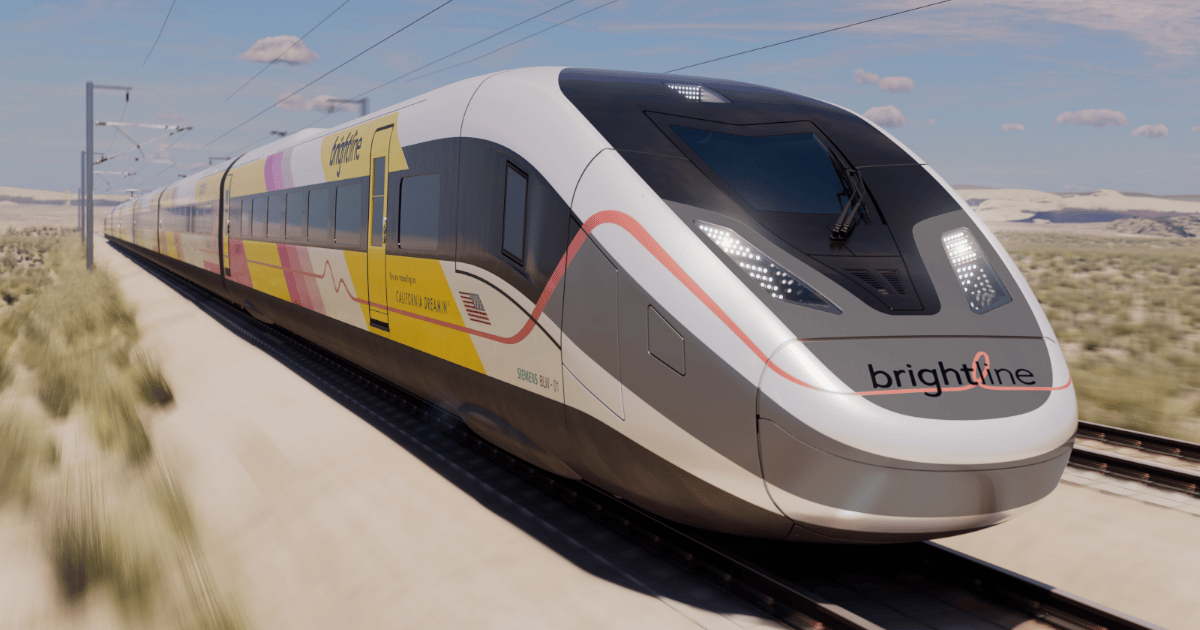
America’s First True High-Speed Rail Line Has a Clearer Completion Date
A long-awaited high-speed rail link between Las Vegas and Southern California now has a clearer — and later — finish line.
Brightline West, a 218-mile high-speed rail project designed to connect Las Vegas to Southern California, is now scheduled for completion in late 2029. The updated timeline marks a shift from earlier hopes that the system could open in time for the 2028 Los Angeles Olympics.
With an estimated cost of at least $12 billion, Brightline West stands out not only for its scale but also for what it represents. The project is widely described as the first “true” high-speed rail line in the United States. Current American “high-speed” rail services, such as Amtrak’s Acela Express, operate as higher-speed upgrades on existing corridors rather than fully dedicated high-speed systems. Brightline West is being built from scratch to support sustained high-speed service.
Brightline West trains are designed for top speeds of around 200 miles per hour (about 322 km/h), with average operating speeds expected to reach roughly 101 mph (165 km/h) over the full route. By comparison, the Acela Express can reach up to about 150 mph on certain segments of the Northeast Corridor, though average speeds remain much lower because trains share track with older infrastructure. Brightline’s design aligns more closely with European high-speed networks, where services like France’s TGV and Germany’s Velaro routinely operate around 186–200 mph (300–320 km/h).
Brightline West is currently in its “civil construction” phase. Work is active at the future Las Vegas station site, located off Interstate 15 near the 215 beltway, while crews focus on preparing the I-15 median and surrounding land for rail infrastructure. The company has not yet announced when track-laying will begin, but fieldwork and land preparation are expected to continue through 2026.
The route will run primarily in the median of Interstate 15, offering a faster alternative to car travel along one of the most heavily congested corridors in the Southwest.
Development began in 2018 when Brightline acquired XpressWest, a company with existing permits and plans. California officially approved the Las Vegas–Victorville connection in 2020, and Caltrans entered into a lease agreement allowing construction within the I-15 median.

Big Deals
Humain secures $1.2B to enhance AI infrastructure in Saudi Arabia.
Zipline raises $600M to expand drone delivery across the U.S.
Sage Geosystems lands over $97M to build the first commercial pressure geothermal power plant.
Norwegian sovereign wealth fund Norges completes acquisition of London mixed-use building for £300M.
GreenCell Mobility brings in $89M to expand electric bus fleet.
AJ Capital Partners obtains $475M loan for Nashville mixed-use development.
Zanskar raises $115M to develop AI-driven geothermal energy solutions.
Extra Reads
Tata Group will invest $11B in new Maharashtra Innovation City.
Sphere Entertainment plans to build a 6,000-seat immersive “mini-Sphere” entertainment venue near Washington, D.C.
What exactly is being built in AI infrastructure? Nvidia's CEO explains.
Lemonade markets a historic industry shift, halving Tesla Full Self-Driving car insurance premiums.
UK approves China's massive new embassy in London, raising security concerns.
New Jersey enacts America's most sweeping e-bike licensing mandate to enhance rider safety.
UAE partners with Telangana to develop India's first net-zero smart city.
Denmark replaces streetlights with red LEDs to protect bats.
China introduces flexible urban planning rules to enhance community development.
New NYC law mandates landlords install AC units for all rentals by 2030.
California surpasses electric vehicle goal despite declining federal support.
Micron breaks ground on $100B New York chipmaking plant.
U.S. defense tech firm Anduril Industries plans a billion-dollar expansion in Long Beach, CA.