- NextMetropolis
- Posts
- America Kickstarts Next Era of Aviation, Abu Dhabi’s Giant Buildout, California Incentivizes Better Cities, Google Maps’ Transformation
America Kickstarts Next Era of Aviation, Abu Dhabi’s Giant Buildout, California Incentivizes Better Cities, Google Maps’ Transformation

Editorial Staff
March 16, 2026


Here’s our latest roundup of the news and trends shaping the future of cities and urban development.
You Should Know
Last Friday, President Trump signed two executive orders aimed at improving U.S. housing affordability. The first order eases mortgage lending rules for community banks. The second order directs federal agencies to reduce regulatory barriers that increase housing construction costs.
Desalination infrastructure has become a critical target in Iranian strikes. In countries such as Saudi Arabia, Kuwait, Bahrain, and the United Arab Emirates, desalination can supply up to 90% of drinking water. The Middle East accounts for more than 40% of the world’s desalination capacity, with roughly 400 plants across the region.
The U.S. construction backlog rebounded in February but remains near four-year lows.
This is a great world population density map. Use the zoom feature!

Worth Watching
See Unitree’s kung fu bots perform in front of a temple (no AI-generated video).
Why Germany’s infrastructure is crumbling.
A look at Hong Kong’s planned $8B “ground skyscraper,” Central Yards.


America Kickstarts the Next Era of Aviation
In an effort to win the next global aviation race, the U.S. is launching one of the largest real-world testing environments ever created for next-generation aircraft. Electric air taxis, autonomous aircraft, and other advanced aviation technologies are set to begin trials across 26 states starting in summer 2026.
The initiative is part of the Advanced Air Mobility and Electric Vertical Takeoff and Landing Integration Pilot Program (eIPP), announced by the U.S. Department of Transportation (DOT) and the Federal Aviation Administration (FAA).
The program is aimed at creating an entirely new transportation layer for cities. Today, urban mobility largely operates across two systems: ground transportation and traditional aviation. eIPP introduces a third layer—low-altitude urban aviation.
The three-year program is designed to accelerate the safe integration of electric vertical takeoff and landing (eVTOL) aircraft and other emerging aviation technologies into the national airspace. Eight pilot projects will test new aircraft and operational concepts across multiple regions of the country. Notably, this marks the first time the U.S. will test air taxis at a national scale rather than through isolated city trials.
Unlike earlier aviation pilot programs that focused on small drones, the eIPP will test larger aircraft capable of carrying passengers or cargo and weighing more than 1,320 pounds. These aircraft may operate with pilots, optionally piloted systems, or fully autonomous flight technologies.
The trials will examine a wide range of potential applications, including urban air taxi services, regional passenger transportation, cargo logistics networks, and autonomous aviation systems. Regulators say the program will generate operational data and experience that will help inform future national policy and regulatory frameworks for advanced air mobility.
Several leading developers of electric aircraft will participate in the program, including Joby Aviation, Archer Aviation, BETA Technologies, Electra, and Wisk, a Boeing subsidiary. Additional technologies involved in the trials include Elroy Air’s Chaparral autonomous cargo drone and Reliable Robotics’ takeoff-to-touchdown autonomy system.
The selected projects span multiple regions of the country. In the Northeast, the Port Authority of New York and New Jersey will work with Archer, Joby, BETA, and Electra to pursue 12 operational concepts, including passenger flights at the Manhattan heliport. In Texas, companies will study regional air taxi networks connecting Dallas, Austin, San Antonio, and eventually Houston. Other projects will test cargo and medical flights in rural areas, offshore logistics flights supporting energy production in the Gulf of Mexico, and autonomous cargo operations centered around Albuquerque, New Mexico.
Developers participating in the program will also be allowed to establish temporary infrastructure such as vertiports and electric charging stations, though companies will be responsible for funding those facilities themselves. Participants must also share operational data from the trials with regulators, with most results expected to be publicly available unless deemed confidential or proprietary.

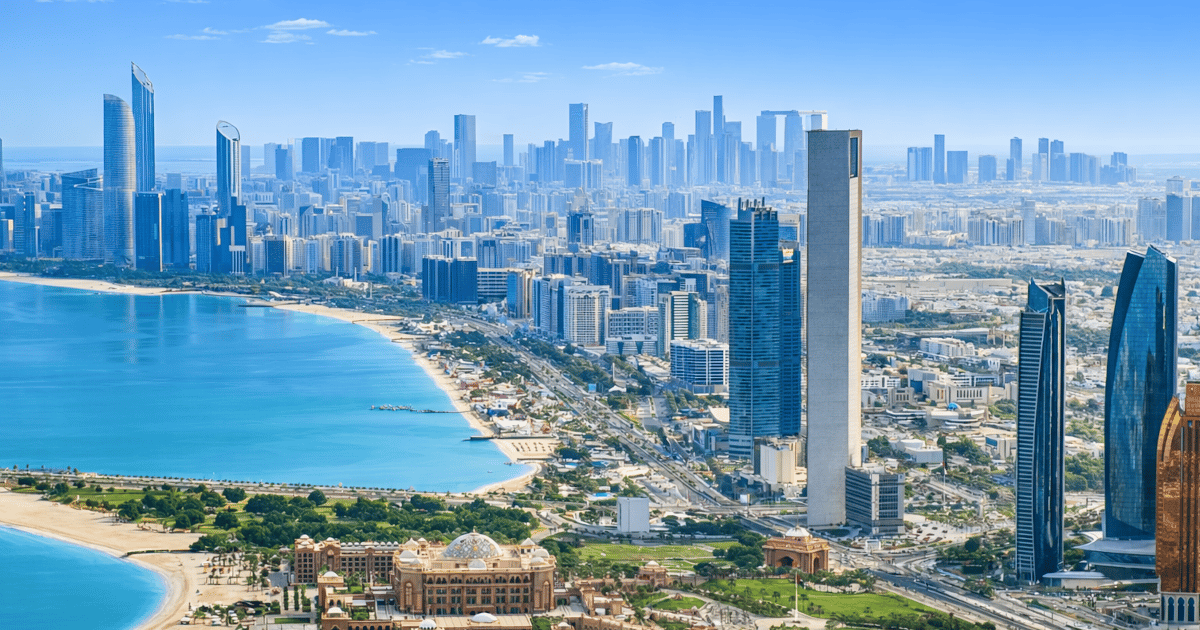
Abu Dhabi Fast-Tracks a Mega-City Expansion
The pace of urban development in Abu Dhabi is breathtaking. The emirate’s Department of Municipalities and Transport (DMT) recently announced that nearly 75 million square meters of development was approved in 2025, representing a 137% year-over-year increase.
The physical scale of this expansion is striking. Seventy-five million square meters of approved Gross Floor Area (GFA) is roughly equivalent to constructing a new downtown the size of Chicago’s. Put another way, it’s comparable to building about 750 Empire State Buildings (or 200 Burj Khalifas).
Housing accounts for the largest share of these approvals. Plans call for nearly 190,000 residential units across both new communities and existing neighborhoods. More than 158,000 of these units are market housing, while approximately 30,000 homes are designated for UAE nationals. To put the scale in perspective, New York City typically builds between 15,000 and 30,000 housing units per year.
These residential developments are expected to be supported by a broad network of community infrastructure, including schools, healthcare facilities, community majlis, and retail destinations designed to support daily life in expanding neighborhoods.
Beyond housing, industrial and technology projects are also major drivers of activity. Newly approved developments include industrial zones, data centers, and advanced manufacturing facilities intended to support Abu Dhabi’s digital economy, logistics sector, and technology-focused industries. The hospitality and tourism sector is expanding as well, with projects expected to add nearly 5,000 hotel keys across multiple destinations. Together, this mix of development suggests the emirate is pursuing a strategy to build a diversified, post-oil economic ecosystem.
To support this pace of growth, DMT has introduced several regulatory and digital reforms. The agency reduced the approval timeline for master developers by 60 days, helping accelerate project delivery while maintaining compliance with regulatory standards. In many major Western cities, development approvals often take one to three years.
A key component of this effort is BINAA, an AI-driven permits platform launched in June 2025. The system has reduced the average time required to issue a residential villa building permit by 57% and lowered permit resubmissions by 53% by automating complex technical reviews.
In total, more than 11,000 building permits were issued across Abu Dhabi in 2025, representing a 15% increase compared with the previous year. DMT also conducted training workshops for more than 7,000 consultants and contractors to help the industry adapt to evolving regulatory and market requirements.

How California Incentivizes Residents to Improve Cities
Across California, cities and state agencies are using incentive-based programs to address urban challenges—from housing shortages to climate resilience and transportation emissions. These programs combine environmental sustainability, affordability, and quality-of-life improvements, encouraging residents to directly participate in solving urban problems.
Here are several standout examples:
Palo Alto pays people to bike to work. The city launched the Bike Love app, which rewards residents for commuting without a car using bikes, e-bikes, scooters, or other micromobility options. Users typically earn about $5 per qualifying commute, which can add up to as much as $599 per year. Rewards are deposited onto a virtual Visa rewards card within the app. The program has already eliminated roughly 2.9 million vehicle miles traveled and more than 1,100 tons of emissions.
San Jose now allows backyard homes to be sold as condos. Last summer, the city became the first in California to allow accessory dwelling units (ADUs)—small homes often built in backyards—to be sold separately as condominiums. This policy enables homeowners to construct backyard cottages and sell them as independent properties, creating new entry-level housing within established neighborhoods. ADUs could help many Californians finally break into homeownership while expanding housing supply without requiring large apartment buildings or major neighborhood redevelopment.
Cities pay residents to replace lawns with drought-resistant landscaping. Many California municipalities offer incentives for converting traditional lawns into drought-tolerant gardens. Glendale provides rebates of up to $3 per square foot for grass removal, while Fresno offers about $2 per square foot for lawn-to-garden conversions.
Cities offer rebates for rainwater capture. Several Bay Area cities provide rebates for rain barrels, typically ranging from $70 to $200 per barrel. In Santa Barbara, stormwater capture projects can receive rebates of up to $5,000 for homes and $15,000 for larger properties. These programs help reduce flooding, conserve water, and strengthen urban resilience.
Sacramento gives away free trees. The city operates one of the longest-running urban cooling incentive programs in the U.S. Residents and business owners can receive up to ten five-gallon trees, along with delivery, planting guidance, and maintenance support. The program helps expand the urban canopy while reducing heat and lowering cooling costs for buildings.
Alameda County residents receive rebates for new e-bikes. In 2025, Ava Community Energy launched the $10 million, three-year “Ava Bike Electric” program to provide residents with $400 to $1,500 rebates for purchasing new e-bikes. The initiative offers larger incentives for cargo and adaptive bikes and provides income-qualified participants with additional support, including up to $250 for safety equipment. During the program’s first six months, it helped fund the purchase of more than 2,700 new e-bikes.


Google Maps’ Biggest Upgrade in Over a Decade
Take note, city dwellers. Last Thursday, Google announced the biggest update to Google Maps in more than 10 years, marking a transformative upgrade to the world’s most widely used navigation app.
Google Maps is introducing a conversational search feature called Ask Maps and a redesigned Immersive Navigation system. No surprise—both features are enabled by Google’s Gemini AI models.
Ask Maps allows users to ask complex, real-world questions directly inside the Google Maps app. Instead of searching through listings or reviews, users can ask prompts such as these:
“Show me places with clean public restrooms near me.”
“Where are cozy coffee shops to work from with free Wi-Fi?”
“Great dinner spots open late and good vegetarian options within a 5-mile radius.”
The system responds conversationally and displays results on a customized map, allowing users to quickly visualize nearby options.
The feature can also help plan trips. For example, a user traveling to the Grand Canyon, Horseshoe Bend, and Coral Dunes could ask for recommended stops along the route. Maps then provides directions, estimated travel times, and suggestions drawn from its database of more than 300 million places, incorporating insights from over 500 million contributors in the Maps community.
Ask Maps also personalizes responses based on activity within a user’s Maps account, such as places previously searched for or saved.
Google is also introducing Immersive Navigation, which redesigns the driving interface with more detailed visuals and route guidance. The update adds a 3D map view that shows nearby buildings, overpasses, terrain, and road features such as lanes, crosswalks, traffic lights, and stop signs.
Gemini models help power the system by analyzing imagery from Street View and aerial photos to better represent real-world surroundings. Google Maps also processes more than 5 million traffic updates every second, allowing the platform to account for changing road conditions.
Immersive Navigation introduces smart zoom to show more of the route ahead. The system can also explain trade-offs between alternate routes.
Most Google Maps users do not yet have access to Ask Maps or Immersive Navigation. To find Ask Maps, look in the search area at the top of the screen. If you don’t see it, try updating the Google Maps app or check back later. The new features are being rolled out gradually, starting in the U.S. They often appear first in the latest Android version of Google Maps.

Big Deals
Google acquires Intersect Power for $4.75B, creating renewable developer IPX Power.
Cypress Creek acquires 2.5-GW Arkansas solar-plus-storage project.
Mind Robotics raises $500M for industrial AI robots.
Arevon secures $920M financing for California Nighthawk battery project.
Savills agrees to $1.1B acquisition of real-estate investment firm Eastdil.
Redwood West–led JV buys $530M California retail complex.
Autonomous A2Z raises $30M pre-IPO for autonomous mobility expansion.

Extra Reads
Penzance announces $4B data center investment in West Virginia.
Texas housing shortage worsens as population growth outpaces home construction.
Wayve, Uber and Nissan collaborate to develop autonomous robotaxi services.
Sacramento partners with experts to develop strategies reducing urban heat.
India approves $105B Jal Jeevan Mission and infrastructure projects.
FIFA World Cup host cities receive $100M for transit upgrades.
Tesla, Google and partners launch coalition to optimize electricity grid usage.
Konza Technopolis launches electricity distribution within Kenya’s smart city.
Nestoria pushes 3D housing to transform India’s construction industry.
Vancouver approves first official development plan guiding future city growth.
P&G’s Gillette invests $1B to build new Boston HQ and innovation center.
Georgia's first artificial island unveils smart city vision for the Black Sea.
Tesla receives approval to supply electricity to homes across Britain.
U.S. adoption of zero-emission buses surpasses 8,000 vehicles nationwide.